
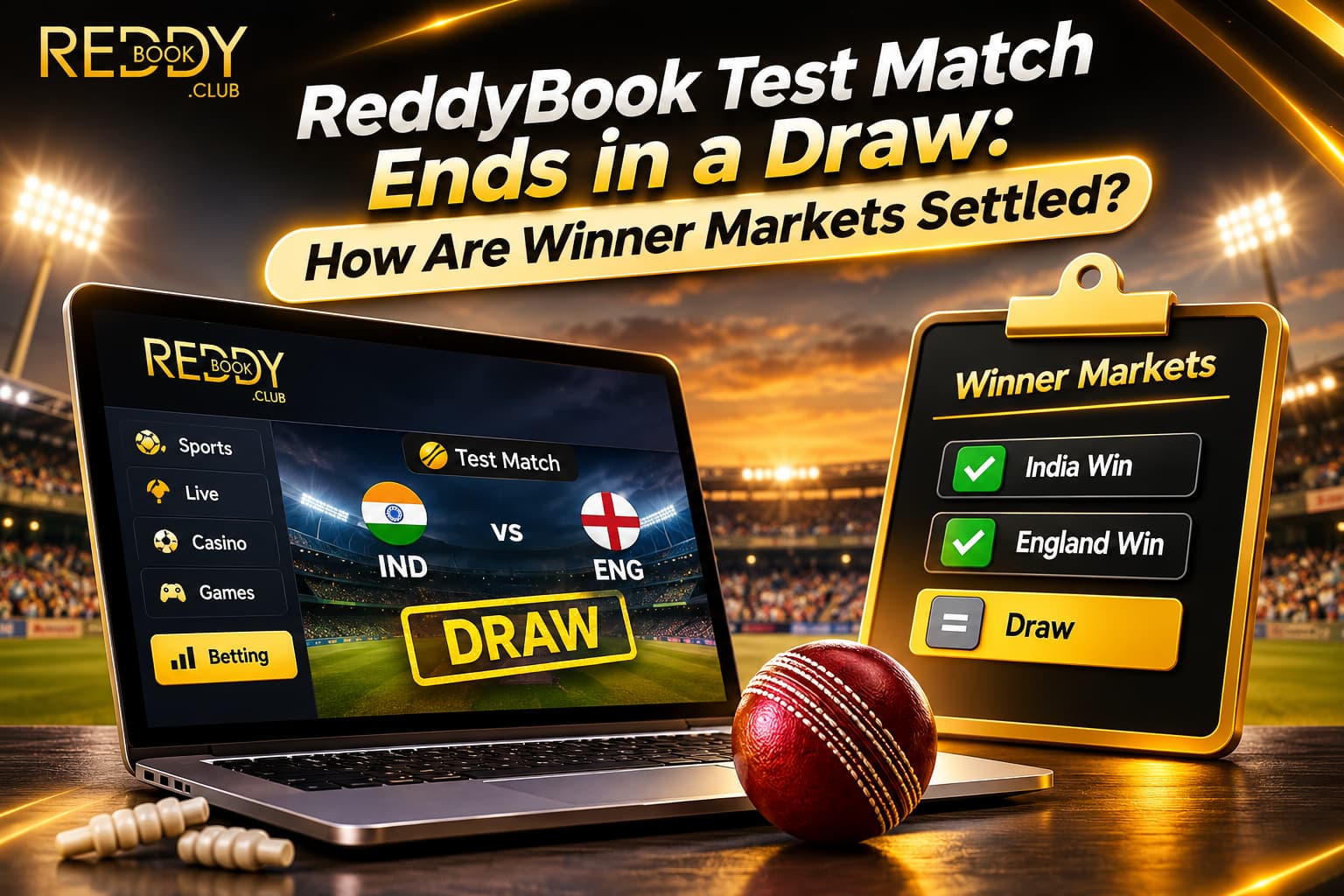
Test cricket is different from shorter formats because a match can continue for five days without producing a winning team. Sometimes both sides bat well, bowlers struggle to take wickets, or rain reduces the number of overs available. When the final day ends without a winner, the match may be declared a draw. For cricket followers using ReddyBook, this can raise an important question: what happens to a winner market when the Test match finishes without either team winning?
Many users searching for reddy book instantly want to understand the final result and how it may affect an existing market selection. At ReddyBook, we know that a draw can be confusing, especially when a user expected one team to win. The important point is that different markets may have different settlement rules. A two-way winner market may be treated differently from a three-way market that includes the draw as a separate outcome.
A Test match draw does not automatically mean that every market is cancelled or that every stake is returned. The result depends on the original market conditions, the available selections, and the operator’s published settlement rules.
What Happens When a Test Match Ends in a Draw?
A Test match normally allows up to five scheduled days of play. During this period, both teams try to score runs, take wickets, and create a winning position.
However, winning is not always possible before the available playing time ends.
If neither team meets the conditions needed for victory and the match is not tied, the official result may be a draw.
At ReddyBook, we believe understanding the cricket result is the first step towards understanding any related winner market.
How a Draw Happens in Test Cricket
A draw can happen when the batting team successfully survives until the end of the final day’s play.
For example, one team may set a target of 350 runs. The other team may finish on 210 for five wickets when the scheduled playing time ends.
Because the chasing team has neither reached the target nor lost all its wickets, the match finishes as a draw.
Rain interruptions can also contribute to drawn matches by reducing the time available for a result.
For ReddyBook readers, the important point is that a draw is an official cricket result, not simply an unfinished score.
Why a Draw Is Different From a Tie
A tie occurs when the teams finish with equal aggregate scores and the side batting last is all out, or its innings is otherwise completed under the relevant playing conditions.
A draw occurs when the match ends without a win or tie.
These results are not interchangeable.
At ReddyBook, we want readers to understand this distinction because a market may include separate conditions for a draw and a tie.
A settlement should follow the official result and the terms of the specific market.
ReddyBook Test Match Winner Market Settlement Explained
A winner market concerns the outcome of a match.
In Test cricket, the result may be a win for either team, a draw, or, much less commonly, a tie.
However, not every winner market includes all these outcomes as separate selections.
At ReddyBook, we want users to understand that the original market description is essential when interpreting settlement.
What Is a Test Match Winner Market?
A Test match winner market usually asks which team will win the match.
Depending on the operator, it may show two teams as selections or include a draw as a third option.
The market structure determines how the available outcomes are represented.
A two-selection market may have special rules for a draw, while a three-selection market can settle a draw as its own outcome.
For ReddyBook users, the market title alone may not explain every condition.
The published rules and original selections are needed to determine the correct treatment.
Why Market Rules Matter More Than Assumptions
Some users assume that selecting a team means they must lose their stake whenever that team fails to win.
Others assume that a drawn Test automatically produces a refund.
Neither assumption is reliable across every market.
At ReddyBook, we believe the correct approach is to distinguish general market conventions from the specific operator’s published rules.
We have not independently verified ReddyBook’s current Test cricket settlement policy.
Therefore, the examples in this article explain common market structures rather than guaranteeing a particular ReddyBook outcome.
How Two-Way Winner Markets Handle a Test Match Draw
A two-way winner market normally presents two possible team selections.
For example, a market may display India and England without showing a separate draw option.
This can create confusion if the official Test match finishes in a draw.
Understanding a Two-Way Match Winner Market
A two-way market may be designed around the possibility that one of the listed teams wins.
When neither team wins, the operator’s rules determine what happens.
Some operators void qualifying two-way winner selections after a draw.
Other markets may use different conditions depending on the precise market description.
At ReddyBook, we want readers to understand that the absence of a draw option does not, by itself, establish a guaranteed refund.
When a Draw May Lead to a Voided Market
In a market where the rules specify that a draw voids two-way winner selections, the original stake is generally returned.
For example, suppose a user selected India in a two-way Test match winner market.
If the official result is a draw and the published rules require voiding, the selection would be settled as void rather than as a winning or losing team outcome.
However, this is an illustrative example.
For ReddyBook users, the actual treatment must be checked against the rules applicable to the original market.
Why a Void Is Different From a Win
A void selection is not a winning selection.
It generally means that the relevant stake is returned under the market rules.
A winning selection, by contrast, is settled according to the agreed odds and applicable conditions.
At ReddyBook, we believe this difference is important because a returned stake should not be confused with a successful winning outcome.
The distinction may also affect how a transaction appears in account records.
How Three-Way Winner Markets Handle a Test Match Draw
A three-way winner market includes three separate outcomes.
For a Test match, these may be Team A win, Team B win, and draw.
This structure is different from a two-way market because the draw is directly included as a possible result.
Understanding the Draw Selection
Suppose a three-way market includes India win, England win, and draw.
If the official Test result is a draw, the draw selection would ordinarily be the successful outcome under standard three-way settlement rules.
Selections on India or England to win would ordinarily be unsuccessful.
At ReddyBook, we want readers to understand that a three-way market does not normally provide an automatic refund simply because neither team won.
The draw is one of the listed outcomes.
Why Team Winner Selections May Lose in a Draw
A selection on a team to win requires that team to achieve the relevant victory result.
If the match finishes in a draw, neither team has won.
In a standard three-way market, this means team-win selections do not match the official outcome.
For ReddyBook users, the important point is that the draw option changes how the market represents possible results.
The original market structure should always be considered when reviewing settlement.
ReddyBook Test Match Draw Settlement: A Practical Example
Consider a Test match between India and Australia.
India scores 420 runs in its first innings, while Australia responds with 390.
India then declares its second innings and sets Australia a challenging target.
Australia begins the final day’s play needing a large number of runs but decides to defend its wickets as the match progresses.
At the close of play, Australia has not reached the target, and India has not dismissed the batting side.
The official result is a draw.
Example of a Two-Way Market
Suppose the market displayed only India win and Australia win.
If its rules stated that a draw voids the market, both team selections would be treated as void.
The original stakes would generally be returned according to those conditions.
At ReddyBook, we want readers to recognise that this outcome depends on the stated market rules.
It should not be assumed without checking them.
Example of a Three-Way Market
Now suppose the market displayed India win, Australia win, and draw.
Under standard three-way rules, the draw would be the successful selection.
India-win and Australia-win selections would not be successful because neither team won.
For ReddyBook readers, this example shows why two markets referring to the same cricket match may produce different settlement results.
What Does Void Mean in ReddyBook Winner Markets?
A void market is one where the relevant selection is cancelled for settlement purposes under the applicable rules.
The usual result is the return of the original stake.
However, different operators may apply voiding conditions to different situations.
At ReddyBook, we want readers to understand that a void outcome should be based on a defined market rule.
Why a Market May Be Voided
A market may be voided when the conditions required for valid settlement have not been met.
This could involve a specific match interruption, a market error, or a result covered by a voiding rule.
However, the circumstances depend on the individual market.
A Test match draw is not a universal reason to void every cricket market.
For ReddyBook users, the exact market conditions remain important.
Does a Void Return the Original Stake?
In ordinary betting terminology, a void selection generally results in the return of the original stake.
It does not normally create a winning profit.
However, the way a void selection affects a combined or multiple selection can differ from a single selection.
At ReddyBook, we believe users should understand these differences before interpreting their settlement records.
ReddyBook ID and Test Match Settlement Records
A ReddyBook ID is an account-related identifier that may be associated with a user’s platform records.
However, an identifier does not determine how a cricket market should be settled.
The settlement depends on the market rules and official result.
Why the Original Market Selection Matters
A settlement record should identify the market and selection involved.
For example, a record referring to a two-way winner market is not the same as one referring to a three-way result market.
At ReddyBook, we believe keeping these distinctions clear can help explain why a drawn Test produces different outcomes across markets.
The original market wording is more useful than relying on memory of the selection.
ReddyBook Login and Winner Market Status
ReddyBook Login is connected with account access, while market settlement concerns the treatment of a particular cricket outcome.
A user may encounter terms such as settled, pending, void, won, or lost.
However, the availability and design of ReddyBook’s current settlement display have not been independently verified.
Why a Market May Remain Pending
A market may remain unsettled while the operator waits for official result information or completes its internal review.
Sometimes a match ends before every related market status has been updated.
At ReddyBook, we want readers to understand that a pending status is not automatically evidence of an incorrect settlement.
It may indicate that the review process has not finished.
Why Settlement Status Should Match the Market Rules
A settled status should reflect the applicable conditions.
For example, a standard three-way market should not be treated as a two-way market simply because the user selected a team.
For ReddyBook readers, the market description and official result are the most important reference points when reviewing a status.
ReddyBook Account and Draw Settlement History
A ReddyBook Account may contain records of previous market activity.
However, we have not independently verified the current account history features or settlement reporting system.
At ReddyBook, we believe a clear transaction history should distinguish the original selection, the market type, and the final outcome.
Why Settlement History Is Important
A settlement history can help explain what happened after a Test match ended.
It may show whether a selection was treated as won, lost, void, or still pending.
These labels have different meanings.
For ReddyBook users, reviewing the original market details is important because a result cannot be understood from the word draw alone.
Why a Returned Stake May Look Different From Winnings
A void settlement generally returns the original stake without the profit associated with a winning selection.
This can make the resulting account record look different from a normal winning settlement.
At ReddyBook, we want readers to understand that a refund and a winning return are not the same financial event.
ReddyBook App and Test Match Result Updates
The ReddyBook App is a search term connected with mobile access to cricket-related information.
However, the availability of an official application and its current settlement features have not been independently confirmed.
At ReddyBook, we believe official cricket results are the starting point for understanding a completed Test match.
Why Live Scores Are Not Always the Final Result
During the final day, a scoreboard may suggest that a draw is likely.
However, the match is not officially drawn simply because one team appears unlikely to win.
A sudden collapse or successful run chase can still change the outcome.
For ReddyBook readers, the final result should be established through official cricket reporting rather than an earlier prediction.
Why Official Result Confirmation Matters
The official scorecard identifies whether the match ended in a win, draw, or tie.
This provides the factual basis for result-based markets.
However, the official cricket result does not replace the operator’s settlement conditions.
At ReddyBook, we believe both pieces of information are needed to understand the final treatment of a winner market.
ReddyBook Betting and Test Match Draw Rules
ReddyBook Betting is associated with cricket market searches, including questions about winner selections and drawn matches.
For Test cricket, a draw is an important possible outcome because the format allows matches to end without a winner.
At ReddyBook, we want readers to understand that market rules must account for the structure of Test cricket.
Read more : ReddyBook Live Sports Betting in 2027: Real-Time Data and Faster Match Insights
Why Test Cricket Markets Differ From T20 Markets
T20 cricket is normally designed to produce a result within a shorter period.
Test cricket can end in a draw after several days of play.
This creates an important difference when describing winner markets.
A market suitable for a shorter format may not have the same conditions as one designed for Test cricket.
For ReddyBook users, it is important not to assume that every cricket market follows identical rules.
Why the Match Format Matters
The match format affects the possible official results.
A Test match can finish in a draw even when both teams have played several innings.
That outcome must be considered when understanding the market.
At ReddyBook, we believe clear market wording helps prevent confusion between a Test draw and other cricket results.
ReddyBook Sports Betting and Draw Market Differences
ReddyBook Sports Betting is another search term associated with cricket market information.
However, the meaning of a draw can vary depending on the market being discussed.
At ReddyBook, we want readers to understand that a match winner market is not the same as every other cricket market.
Match Winner Markets vs Individual Player Markets
A match winner market concerns the overall result.
A player performance market may concern a particular batting or bowling achievement.
For example, a player may score a century during a Test that eventually ends in a draw.
The match draw does not erase the runs scored by that player.
For ReddyBook readers, the settlement of a separate player market depends on its own conditions rather than automatically following the match winner market.
Why Some Markets May Still Have Valid Results
A Test match can produce many completed events before the final result is declared.
Players may score runs, bowlers may take wickets, and innings may be completed.
Some markets based on those events may have already met their settlement conditions.
At ReddyBook, we believe it is important to understand that a drawn match does not automatically cancel every market associated with the game.
ReddyBook Registration and Winner Market Conditions
ReddyBook Registration is an account-related topic, while Test match settlement depends on the conditions of the market itself.
An account’s registration status does not change whether the official cricket result is a draw.
At ReddyBook, we want readers to understand that settlement questions should focus on the market’s original terms.
Why Market Terms Should Be Clear
A market should explain what outcome is being measured.
For Test cricket, the wording should make clear whether a draw is included as a separate result or covered by another rule.
Unclear wording can create confusion when the match ends without a winner.
For ReddyBook users, the difference between two-way and three-way selections remains central to understanding settlement.
ReddyBook Download and Draw Settlement Information
The ReddyBook download keyword may appear in searches about mobile access to cricket-related services.
However, installing software does not change the official result of a Test match or the conditions attached to a market.
At ReddyBook, we believe reliable result information is more important than the device used to view it.
Why Old Screenshots May Cause Confusion
A screenshot may show a market before the match ended.
Another screenshot may show the market after settlement.
These images can appear different because the match status has changed.
For ReddyBook readers, the original market description and final official result provide better context than a screenshot viewed on its own.
ReddyBook Casino and Test Match Winner Markets
ReddyBook casino is a separate gaming-related topic and should not be confused with cricket winner market settlement.
A Test match draw is an official sports result.
It is not determined by the rules of unrelated casino-style games.
At ReddyBook, we want readers to understand that cricket market settlement should be explained through cricket results and the relevant market conditions.
Why Different Gaming Categories Have Different Rules
Different types of games and markets use different outcome conditions.
A cricket winner market depends on a sporting event.
Other games may use separate rules for determining results.
For ReddyBook readers, the important point is to avoid applying rules from one category to another.
What Happens if Rain Causes a Test Match Draw?
Rain is one of the common reasons a Test match may finish without a winner.
Several sessions of play may be lost because of wet weather, poor light, or unsafe ground conditions.
However, a rain-affected draw is still an official draw if that is the result declared under the playing conditions.
Does Rain Automatically Void a Winner Market?
No. Rain alone does not automatically mean that every market is void.
The treatment depends on the original market rules and the official result.
For example, a standard three-way market may still settle on the draw outcome when rain contributes to the match finishing without a winner.
At ReddyBook, we believe readers should distinguish the reason for a draw from the settlement conditions.
What if the Match Is Abandoned?
An abandoned match may raise different settlement questions from a completed Test declared drawn.
The correct treatment depends on the official status and the market’s rules concerning abandoned or interrupted events.
For ReddyBook users, it is important not to treat abandonment and a normal draw as identical situations.
What if a Test Match Ends in a Tie Instead of a Draw?
A tie is rare in Test cricket.
It happens when the teams finish with equal aggregate scores and the final innings is completed without a winning result.
A draw, by comparison, occurs when the match ends without either team winning or the scores meeting the conditions for a tie.
Why a Tie May Have Different Settlement Rules
Some markets may include special provisions for tied matches.
Others may treat a tie differently depending on whether it was included as an available selection.
At ReddyBook, we believe readers should avoid assuming that draw settlement rules automatically apply to ties.
The exact market conditions remain important.
Why a ReddyBook Winner Market May Be Settled Incorrectly
Settlement questions may arise when the displayed result appears inconsistent with the original market conditions.
For example, a user may believe that a two-way market should have been voided after a draw.
However, without the published rules, it is not possible to determine whether the settlement is correct.
Why the Market Description Should Be Reviewed
The first issue is identifying the exact market.
Was it a two-way winner market, a three-way result market, or a different type of selection?
At ReddyBook, we believe this question is essential because different markets may produce different outcomes from the same match.
Why the Official Scorecard Matters
The official scorecard confirms the cricket result.
If the match was declared a draw, that result should be used when applying the relevant settlement rules.
However, the scorecard does not establish whether a particular selection should be voided or lost.
For ReddyBook users, the market terms must also be considered.
Why Settlement Disputes Need Accurate Records
A dispute is easier to understand when the original market name, selection, result, and settlement status are available.
Without these details, it may be difficult to identify the reason for the disagreement.
At ReddyBook, we believe clear records are important for explaining how a result-based market was handled.
Can a Drawn Test Match Affect Multiple Selections?
Some users may encounter combined selections involving more than one cricket market.
When one selection is void, the treatment of the overall combination can depend on the operator’s rules.
This is different from a single-selection market.
How a Void Selection May Affect a Combination
Under some common market rules, a void selection in a multiple is treated at odds of 1.00, while the remaining valid selections continue to determine the result.
However, this is not universal.
At ReddyBook, we want readers to understand that the treatment of combined selections must follow the published conditions.
Why One Draw Does Not Always Cancel Everything
A draw may affect one selection without automatically cancelling every other market.
For example, a completed player performance market may remain valid even if the overall match ends in a draw.
At ReddyBook, we believe readers should review each market separately rather than assuming the entire set of selections has the same outcome.
Legal Considerations for Test Match Winner Markets in India
Cricket market settlement is a technical topic, but real-money wagering also raises legal questions.
India’s Promotion and Regulation of Online Gaming Act, 2025, introduced restrictions on online money games and related services.
At ReddyBook, we want readers to understand that learning how a market is commonly settled does not establish that participation is legally permitted.
Why Market Rules Do Not Replace Legal Requirements
A website may publish detailed settlement conditions.
However, those conditions do not override applicable law.
For Indian users, legal permission and market settlement are separate issues.
The examples in this article explain how different market structures are commonly understood, not how to participate in prohibited real-money gaming.
What Users Should Understand About ReddyBook Test Match Draw Settlement
When a Test match ends in a draw, the outcome of a winner market depends on the market structure and the applicable rules.
A two-way winner market may be voided if its conditions specify that treatment.
A standard three-way winner market may settle the draw as the successful outcome, while team-win selections are unsuccessful.
At ReddyBook, we believe this distinction is the most important point for readers trying to understand drawn Test matches.
The official cricket result, original market description, and published settlement conditions should be considered together.
A draw does not automatically mean that every selection is refunded, and it does not mean that every market connected with the match is cancelled.
Understanding ReddyBook Winner Markets After a Draw
Test cricket allows matches to finish without a winner, making draws an important part of understanding the format.
For ReddyBook readers, the difference between a two-way market, a three-way market, and a separate player performance market can explain why settlement outcomes vary.
A void selection, an unsuccessful team-win selection, and a successful draw selection represent different results.
At ReddyBook, we believe clear explanations help users understand these differences without relying on assumptions.
The final answer to any specific settlement question must come from the official match result and the rules that applied to the original market.
Until ReddyBook’s exact settlement policy is independently verified, no particular refund, winning return, or loss should be presented as guaranteed.
FAQs – ReddyBook Test Match Draw and Winner Market Settlement
1. What happens when a Test match ends in a draw on ReddyBook?
When a Test match ends in a draw, the treatment of winner markets depends on the original market conditions. Some two-way markets may be voided, while three-way markets may settle the draw as the successful outcome. ReddyBook’s exact settlement rules have not been independently verified.
2. How are Test match winner markets settled after a draw?
Winner markets are generally settled using the official cricket result and the market’s published rules. A draw may produce different outcomes depending on whether the market offered two or three selections.
3. Is my stake refunded if a Test match ends in a draw?
A refund may apply when the relevant market rules state that a draw makes the selection void. However, refunds are not automatic for every Test match winner market.
4. What is a two-way winner market in Test cricket?
A two-way winner market normally offers two team selections without a separate draw option. Some operators void these markets when a Test finishes in a draw, but the exact settlement conditions must be checked.
5. What is a three-way winner market in Test cricket?
A three-way winner market usually includes Team A win, Team B win, and Draw. Under standard three-way rules, the draw selection is successful when the official match result is a draw.
6. Does a draw mean both teams lose in a winner market?
In a standard three-way market, selections on either team to win are normally unsuccessful when the match ends in a draw. However, two-way markets may follow different settlement conditions.
7. What does void mean in a ReddyBook winner market?
A void selection generally means the market is cancelled for settlement purposes and the original stake is returned. The exact treatment depends on the rules applicable to that market.
8. Is a Test match draw the same as a tie?
No. A draw occurs when the match ends without either team winning or the result being a tie. A tie occurs when the teams finish with equal aggregate scores and the final innings is completed under the relevant playing conditions.
9. What happens if rain causes a Test match draw?
If rain reduces playing time and the official result is a draw, settlement still depends on the market rules. Rain does not automatically void every winner market.
10. Can a Test match winner market remain pending after the match ends?
Yes. A market may remain pending while the operator confirms the official result or completes its settlement review. However, ReddyBook’s actual processing times have not been verified.




Shreya Duptai is the Chief Editor at ReddyBook India, overseeing the development, quality, and accuracy of the website’s editorial content. Her editorial focus includes Indian cricket, sports news, online gaming information, player education, and responsible gaming awareness. As Chief Editor, Shreya focuses on making complex gaming-related topics easier for Indian readers to understand. She promotes clear, informative, and reader-friendly content covering ReddyBook ID, account security, platform features, cricket updates, and online gaming guidelines.